BrandRank.ai Normalization Transformation Rules in Python: A Complete Guide for Data Processing
Learn How Python-Based Normalization Rules Create Consistent, Reliable, and Analysis-Ready Data for Better Analytics and Machine Learning Results.

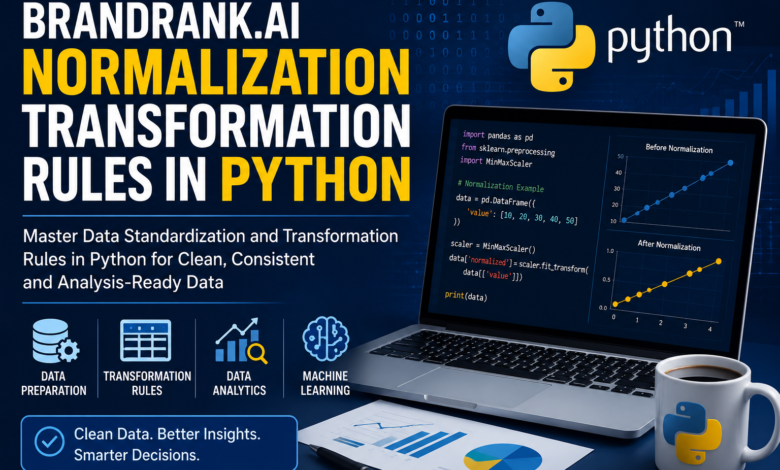
Introduction to BrandRank.ai Normalization Transformation Rules in Python
Data has become one of the most valuable assets in the digital era. Organizations rely on accurate information to make decisions, improve customer experiences, and optimize operations. However, raw data often arrives in different formats, scales, and structures, making it difficult to analyze effectively. This is where normalization transformation rules play an important role.
BrandRank.ai normalization transformation rules in Python help developers and analysts convert inconsistent datasets into structured and standardized formats. By applying transformation rules, businesses can improve data quality, increase analytical accuracy, and prepare information for machine learning applications.
This guide explores normalization concepts, transformation techniques, implementation methods, and practical benefits of using Python for data processing.
Understanding Data Normalization
Data normalization refers to the process of organizing and standardizing data values so they can be compared and analyzed consistently. In many datasets, numerical values may exist on completely different scales.
For example, one column may contain values ranging from 1 to 100, while another may contain values from 1,000 to 1,000,000. Without normalization, analytical models may give excessive importance to larger values.
Normalization helps by transforming data into a common scale while preserving meaningful relationships between values. This process improves model performance and enhances the reliability of statistical analysis.
Why Data Transformation Matters in Modern Analytics
Data transformation is a crucial step in the data preparation pipeline. Before information can be used for reporting, forecasting, or machine learning, it must be converted into a suitable format.
Some common reasons for applying transformation rules include:
- Improving data consistency
- Reducing errors and anomalies
- Enhancing machine learning accuracy
- Supporting cross-platform data integration
- Simplifying reporting processes
- Making datasets easier to interpret
Organizations that invest in proper data transformation often achieve better insights and more reliable business intelligence outcomes.
Key Normalization Techniques Used in Python
Python provides several powerful methods for normalization and transformation. Each technique serves different analytical needs.
Min-Max Scaling
Min-Max Scaling transforms values into a fixed range, typically between 0 and 1.
Formula:
X_scaled = (X - Xmin) / (Xmax - Xmin)
This method is useful when maintaining relationships between minimum and maximum values is important.
Example:
from sklearn.preprocessing import MinMaxScaler
import pandas as pd

data = pd.DataFrame({'score':[10,20,30,40,50]})

scaler = MinMaxScaler()
data['normalized'] = scaler.fit_transform(data[['score']])

print(data)
Z-Score Standardization
Z-score normalization adjusts values according to the dataset’s mean and standard deviation.
Formula:
Z = (X - Mean) / Standard Deviation
This method is commonly used in machine learning and statistical analysis.
Decimal Scaling
Decimal scaling moves decimal points according to the largest absolute value in the dataset.
This technique is straightforward and useful when handling large numerical ranges.
Log Transformation
Log transformation reduces skewness in datasets containing extremely large values.
Python example:
import numpy as np

values = np.array([10,100,1000,10000])
log_values = np.log(values)

print(log_values)
This method is especially effective for financial and marketing datasets.
How BrandRank.ai Supports Data Normalization
BrandRank.ai focuses on helping organizations improve data management and analytical performance. Its normalization transformation rules emphasize consistency, automation, and scalability.
These rules often include:
- Data cleansing procedures
- Value standardization
- Missing value handling
- Format conversion
- Feature scaling
- Automated transformation workflows
When integrated with Python-based pipelines, these capabilities help organizations process large datasets more efficiently.
Implementing Transformation Rules in Python
Python is one of the most popular languages for data transformation because of its extensive ecosystem.
Popular libraries include:
- Pandas
- NumPy
- Scikit-learn
- SciPy
- Dask
A simple transformation workflow may involve:
- Loading data.
- Cleaning missing values.
- Applying normalization.
- Validating results.
- Exporting transformed data.
Example:
import pandas as pd
from sklearn.preprocessing import StandardScaler

df = pd.read_csv("data.csv")

scaler = StandardScaler()

df['sales_normalized'] = scaler.fit_transform(df[['sales']])

print(df.head())
This approach enables analysts to prepare data efficiently for advanced analytics.
Benefits of Using Normalization Rules
Applying normalization transformation rules offers several advantages.
Improved Machine Learning Performance
Many machine learning algorithms perform better when features are scaled consistently.
Better Data Quality
Normalization removes inconsistencies and improves dataset reliability.
Enhanced Analytical Accuracy
Standardized information allows analysts to compare variables more effectively.
Faster Processing
Optimized datasets often reduce computational complexity.
Improved Decision-Making
Organizations gain more accurate insights from clean and structured data.
Common Challenges During Data Transformation
Although normalization provides significant benefits, implementation can present challenges.
Some common issues include:
- Missing values
- Duplicate records
- Outliers
- Inconsistent formats
- Data integration complexities
Addressing these challenges requires careful planning and validation procedures.
Best Practices for Effective Data Normalization
To maximize results, organizations should follow several best practices:
- Understand dataset characteristics before normalization.
- Choose the appropriate transformation technique.
- Validate transformed outputs.
- Document transformation rules clearly.
- Monitor data quality continuously.
- Automate repetitive normalization tasks.
Following these practices helps maintain consistency across projects and teams.
Future of Automated Data Transformation
Artificial intelligence continues to reshape data management processes. Modern platforms increasingly automate normalization, transformation, and validation activities.
Future advancements may include:
- AI-driven transformation recommendations
- Automated anomaly detection
- Real-time normalization pipelines
- Intelligent feature engineering
- Self-optimizing data workflows
These innovations will help organizations process larger datasets with greater efficiency and accuracy.
Conclusion
BrandRank.ai normalization transformation rules in Python provide a structured approach to preparing data for analytics and machine learning. By standardizing values, improving consistency, and reducing data quality issues, normalization helps organizations generate more accurate insights from their information assets.
Python’s rich collection of libraries makes it an ideal choice for implementing transformation workflows, whether for small business reporting or large-scale enterprise analytics. As data volumes continue to grow, effective normalization and transformation strategies will remain essential for achieving reliable and meaningful analytical outcomes.
