What Is Quant Finance
What Is Quant Finance? A Beginner’s Guide to Quantitative Finance

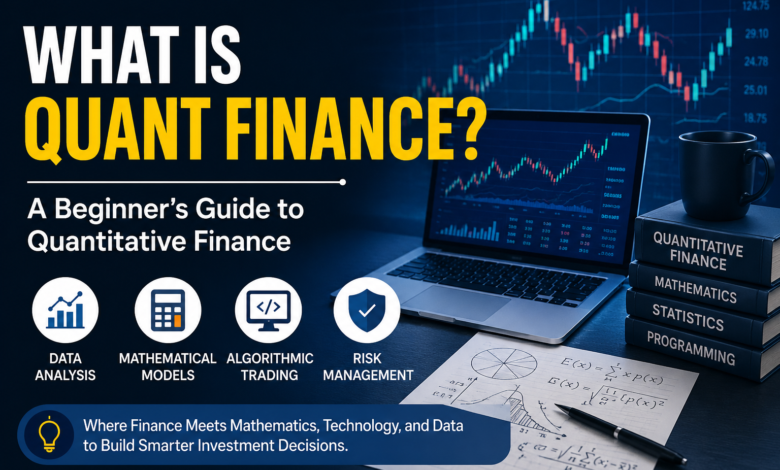
What Is Quant Finance? A Beginner’s Guide to Quantitative Finance
Introduction
Quant Finance, short for Quantitative Finance, is a specialized field that combines finance, mathematics, statistics, and computer programming to analyze financial markets and make data-driven investment decisions. In today’s digital economy, quantitative finance plays a major role in trading, portfolio management, risk assessment, and financial forecasting.
Financial institutions, hedge funds, investment banks, and fintech companies rely on quantitative methods to gain deeper insights into market behavior and improve decision-making processes.
Understanding Quant Finance
Quant Finance involves using mathematical models and statistical techniques to evaluate financial markets and investment opportunities. Professionals in this field, often called Quantitative Analysts or “Quants,” develop algorithms and models that help organizations predict market movements, manage risks, and optimize investment strategies.
Unlike traditional investing, which may rely heavily on human judgment and market sentiment, quantitative finance uses data, calculations, and automation to support financial decisions.
How Quant Finance Works
Quantitative finance works by collecting and analyzing large amounts of financial data. Analysts use mathematical formulas, historical market information, and computer algorithms to identify patterns and trends.
The process generally includes:
- Collecting financial and market data
- Analyzing historical price movements
- Building mathematical models
- Testing investment strategies
- Managing financial risks
- Automating trading decisions
These models help financial professionals make informed decisions based on objective data rather than speculation.
Key Areas of Quant Finance
Algorithmic Trading
Algorithmic trading relies on advanced software systems that can buy and sell financial assets automatically according to specific market conditions and custom-built strategies. This approach can process market information much faster than human traders and helps improve efficiency in financial markets.
Risk Management
Financial institutions use quantitative models to measure and control risks. These models help organizations understand potential losses and develop strategies to minimize financial exposure.
Portfolio Optimization
Quantitative techniques help investors build diversified portfolios that balance risk and return. Mathematical models can determine the most efficient allocation of assets.
Financial Modeling
Financial models are used to estimate future performance, evaluate investments, and support strategic business decisions. These models play an important role in corporate finance and investment management.
Skills Required for Quant Finance
A successful career in quantitative finance often requires expertise in several areas:
Mathematics
Strong knowledge of calculus, linear algebra, and probability theory.
Statistics
Strong analytical skills are required to examine complex datasets and uncover valuable insights that can support financial decision-making.
Programming
Common programming languages include:
- Python
- R
- C++
- MATLAB
- SQL
Financial Knowledge
Understanding financial markets, investment products, and economic principles is essential.
Career Opportunities in Quant Finance
The demand for quantitative professionals continues to grow as financial institutions increasingly rely on data-driven decision-making.
Popular career roles include:
- Quantitative Analyst
- Financial Engineer
- Risk Analyst
- Algorithmic Trader
- Data Scientist in Finance
- Portfolio Analyst
- Investment Research Analyst
These positions are commonly found in investment banks, hedge funds, fintech companies, insurance firms, and asset management organizations.
Benefits of Quant Finance
Quantitative finance offers several advantages:
- Data-driven decision making
- Improved risk management
- Faster market analysis
- Automated trading systems
- Better portfolio performance
- Enhanced financial forecasting
By reducing emotional bias, quantitative methods help create more objective investment strategies.
The Future of Quant Finance
The future of quantitative finance is closely connected with artificial intelligence, machine learning, and big data analytics. As technology continues to evolve, financial institutions are expected to use increasingly sophisticated models to analyze markets and manage investments.
Fintech innovation and advanced computing technologies are making quantitative finance more accessible and powerful than ever before.
Conclusion
Quant Finance is a rapidly growing field that combines finance, mathematics, statistics, and technology to solve complex financial problems. Quantitative finance supports a wide range of financial activities, including automated trading systems, risk evaluation, investment research, and portfolio improvement, making it an essential part of today’s data-driven financial industry.
As businesses and financial institutions continue to embrace digital transformation, the importance of quantitative finance is expected to increase significantly. For students, professionals, and investors interested in finance and technology, quantitative finance offers exciting opportunities for learning and career growth.